





Is My BUZUD CGMs Sensor Accurate?
BUZUD CGMs Readings vs. Blood Glucose Meters
Whether you're new to BUZUD CGMs or have used it before, it's important to review the product instructions carefully before use. Until you're confident in how BUZUD CGMs performs for you, continue using your blood glucose meter (BG meter) for treatment decisions.
Your BG meter will give you one result. If you test again—whether with the same or a different meter—you may get a different value. Meanwhile, your BUZUD CGMs may show a third number. So, how should you interpret these differences?
Understanding Accuracy
Lab-based glucose tests conducted by healthcare professionals are considered more accurate than any at-home device. In clinical studies, both blood glucose meters and BUZUD CGMs are evaluated by comparing their readings to lab results—not to each other.
As a result, BUZUD CGMs readings may not match your meter exactly, but they should be close. You can compare them using what’s called the "20 Rule" (also known as the 20/20 rule) to determine how closely they align.
What Is the 20 Rule?
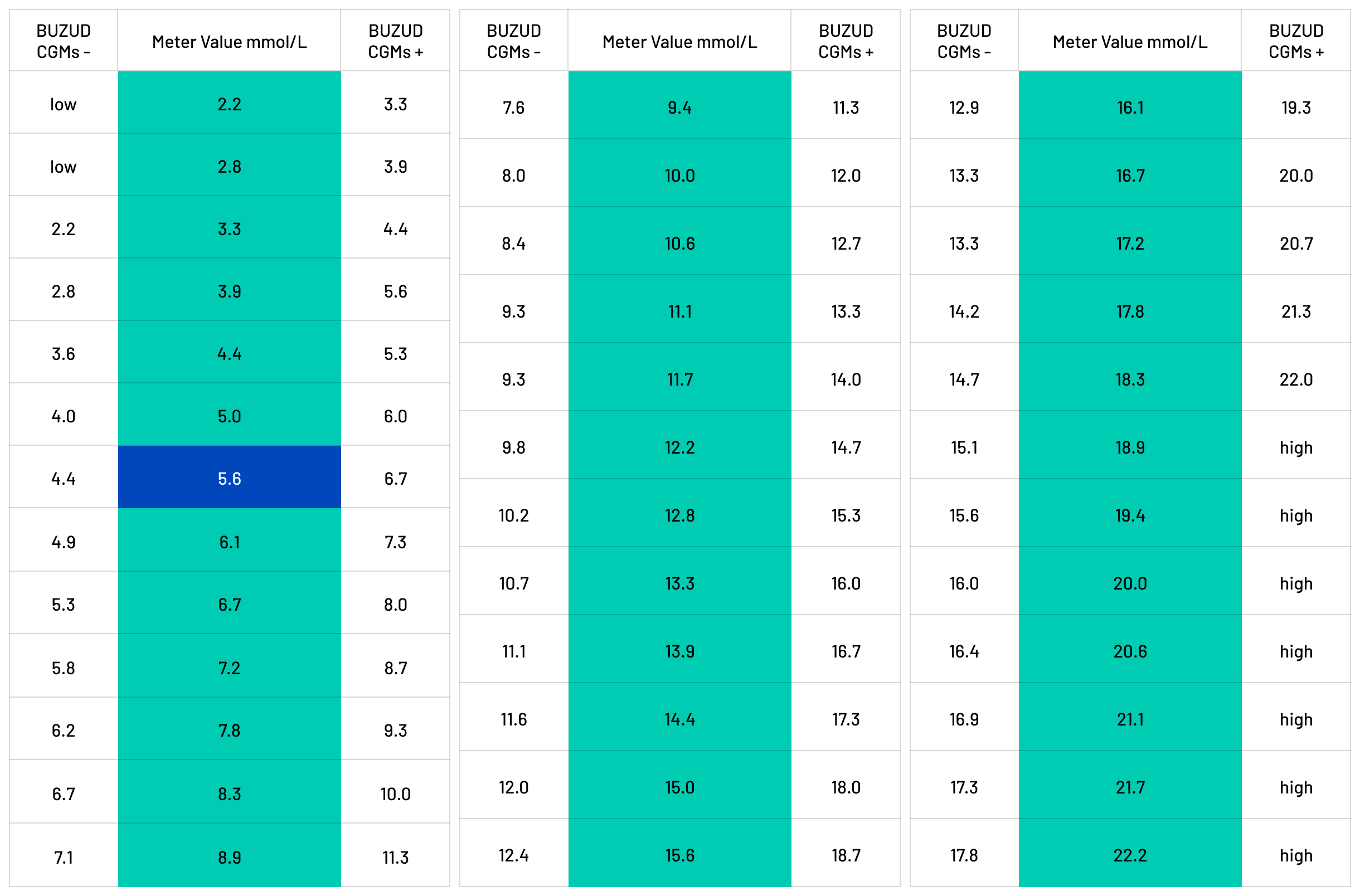
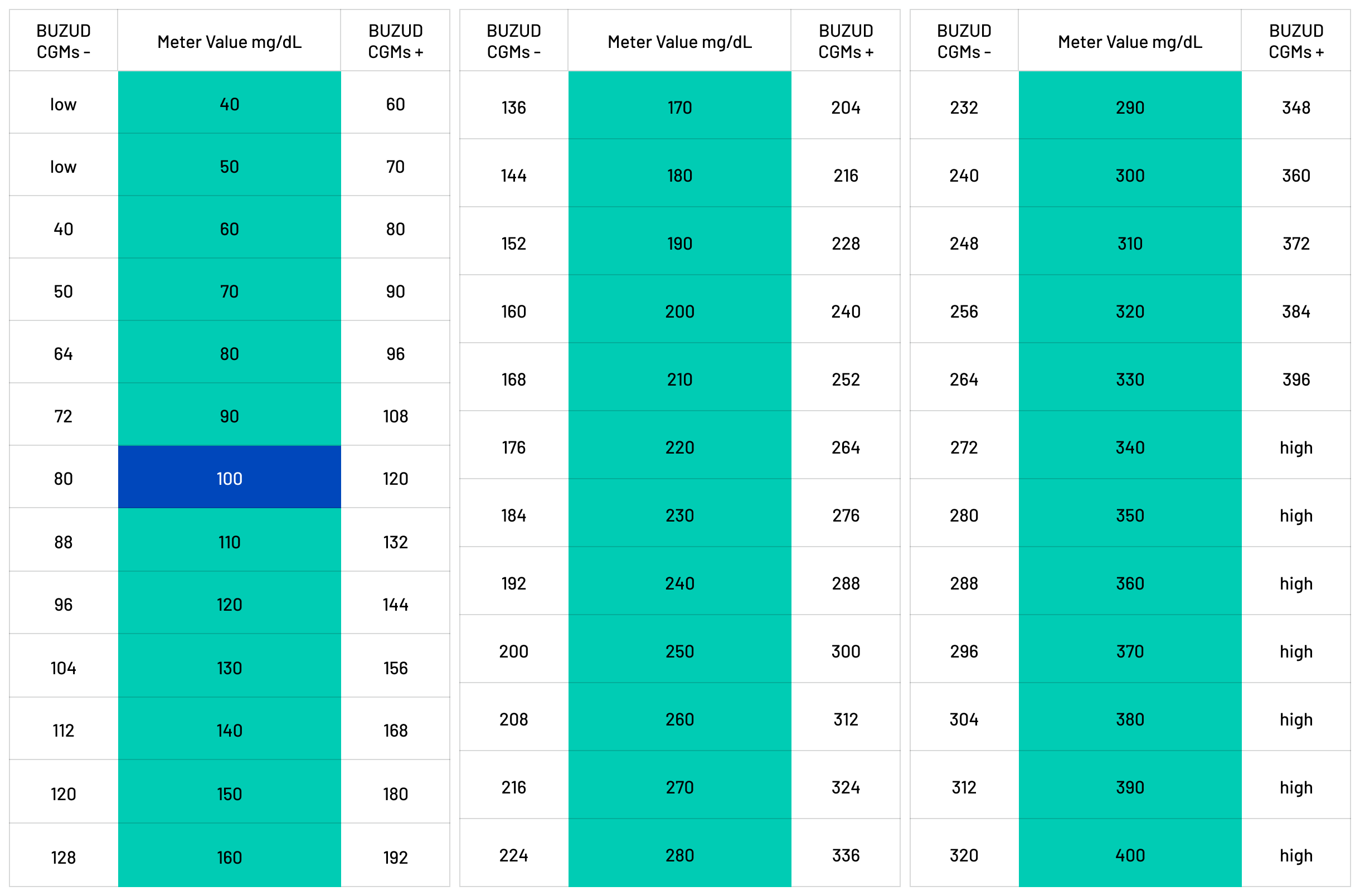
To apply the 20 Rule:
- Locate your meter reading in the center column of the chart;
- The left column (CGMs –) shows the lowest expected CGMs reading;
- The right column (CGMs +) shows the highest expected CGMs reading.
For example, if your meter reading is 5.6 mmol/L (100 mg/dL), then any BUZUD CGMs reading between 4.4 and 6.7 mmol/L (80 to 120 mg/dL) would be considered an acceptable match.
Best Practices for Fingerstick Testing
To ensure accurate meter readings:
- Store your test strips as directed and check expiration dates;
- Wash your hands with soap and water (not hand sanitizer), dry thoroughly, and then test.
Situations That May Cause Temporary Mismatches
First Day of Sensor Use: Readings from a newly inserted sensor may initially vary more from meter values. Accuracy typically improves within the first 24 hours.
Rapid Glucose Changes: During rapid fluctuations, readings may differ because your meter reflects blood glucose levels, while CGMs measure glucose in interstitial fluid, which lags behind slightly. As glucose levels stabilize, readings will better align.
Sensor Compression: Pressure on the sensor (e.g., lying on it while sleeping) can affect accuracy. Once the pressure is relieved, readings usually return to normal.
When Should You Consider Calibration?
Observe your CGMs readings over several hours. If they consistently read higher or lower than your meter and fall outside the 20 Rule, calibration may help.
You may also calibrate if your CGMs readings don’t match how you feel, but your meter results do.
Calibration Guidelines
BUZUD CGMs does not require routine calibration. Although calibration may bring readings closer to your meter values, it doesn’t always improve accuracy relative to lab standards.
If you decide to calibrate:
- Enter the fingerstick value within 5 minutes of testing;
- Avoid calibration during a "Sensor self-check" status.
How to Manually Use the 20 Rule
BUZUD CGMs readings are considered accurate when:
- If the meter value is ≥ 4.4 mmol/L (80 mg/dL), the CGMs reading is within ±20%;
- If the meter value is < 4.4 mmol/L (80 mg/dL), the CGMs reading is within ±1.1 mmol/L (20 mg/dL).
Important Note
This information is intended for BUZUD CGMs users. Please consult your healthcare provider or local guidance for specific usage instructions.